LLMs as a Platform: What Does the Architecture Look Like?
Why enterprises put an LLM platform between their applications and model providers—and what that platform is responsible for.
Consider yourself as an enterprise company
You would not want every application to integrate with every model provider directly:
App → OpenAI
App → Anthropic
App → Gemini
App → Bedrock
That approach creates repeated integration work, inconsistent security controls, and no single place to understand how AI is being used. Every team would need to manage provider credentials, decide which model to use, handle failures, and track cost independently.
Instead, the architecture looks like this:
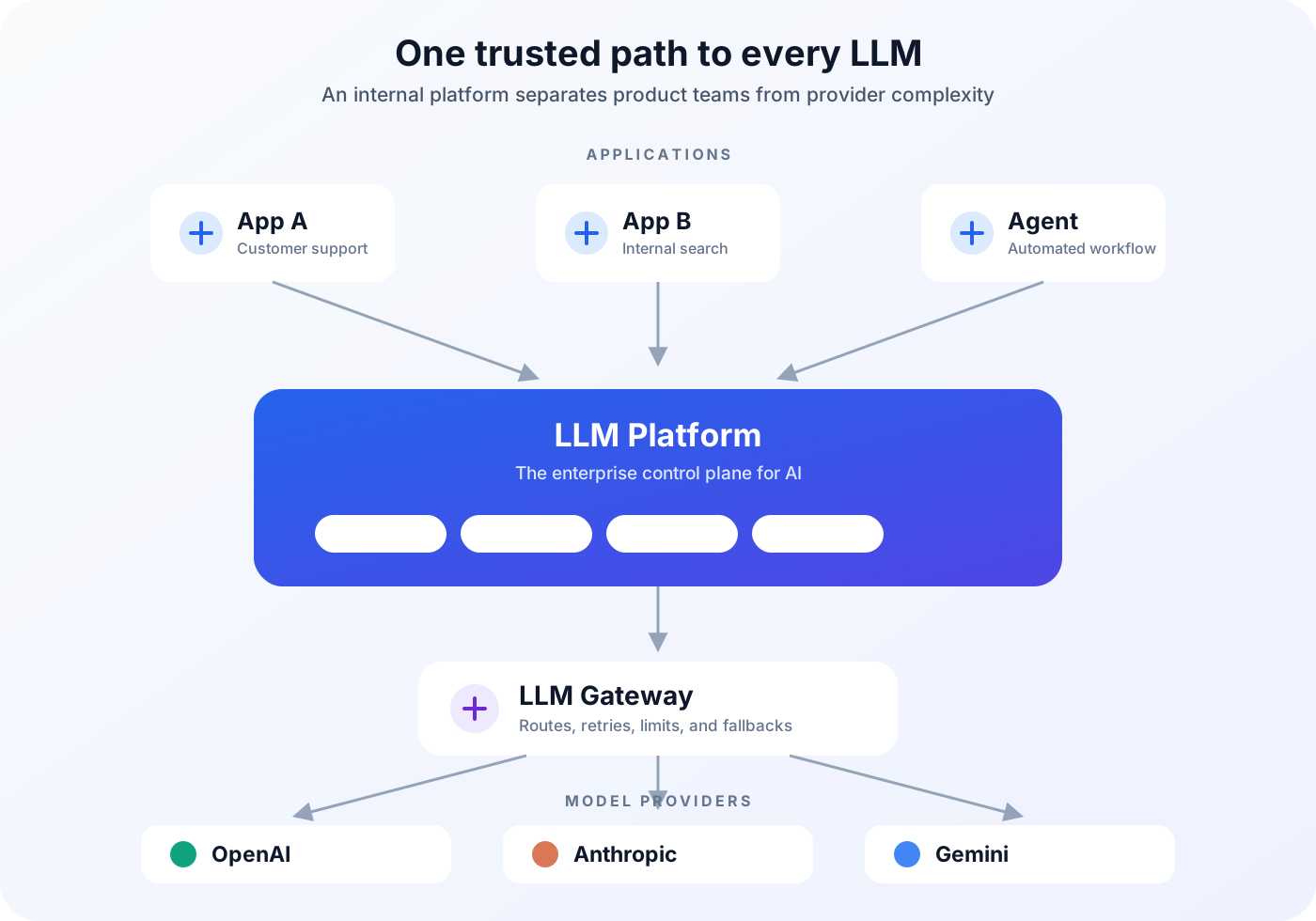
The applications talk to one internal platform. The platform handles the common concerns and uses an LLM gateway to communicate with the external model providers. This is what LLMs as a platform provides: a reliable, governed layer for using language models across the company.
What the LLM platform provides
Model access
The platform gives teams one consistent API for approved models. An application can ask for a capability—such as a fast summarisation model or a high-reasoning model—without each team implementing provider-specific SDKs.
Authentication
The platform authenticates the calling application and manages the provider credentials centrally. Teams do not need direct access to production API keys, and the company can control which applications or users may use which models.
Routing
Routing chooses the right model or provider for a request. For example, a low-cost model may handle classification, while a stronger model handles complex analysis. Routing can also account for region, latency, availability, or data-residency requirements.
Rate limiting
Rate limits protect both the providers and the platform. They prevent one application from consuming all available capacity, help the company stay within provider quotas, and give every application predictable access.
Retries
Model APIs sometimes fail temporarily because of network errors, overloaded capacity, or transient provider errors. The platform can retry safe requests with backoff, so each application does not have to implement the same reliability logic.
Fallback
When a preferred model or provider is unavailable, the platform can send the request to an approved alternative. Fallback rules need to preserve the task’s required quality, cost, privacy, and data-location constraints.
Token tracking
Every request consumes input and output tokens. The platform records token usage by application, team, model, and use case. This makes capacity planning and usage limits possible.
Cost tracking
Token usage becomes cost when it is combined with each provider’s pricing. A central platform can show chargeback or showback reports, set budgets, and alert teams before unexpected AI spend grows too large.
Observability
The platform captures the operational signals needed to run AI features: latency, errors, provider availability, model selected, token volume, and request outcomes. These signals help teams diagnose slow or failing experiences without exposing sensitive content unnecessarily.
Prompt management
Prompts are production assets, not scattered strings in application code. The platform can store versioned prompt templates, test changes, control rollouts, and make it clear which prompt version produced a particular response.
Safety and policies
Finally, the platform enforces company-wide policies before and after model calls. These may include prompt-injection checks, sensitive-data handling, moderation, content filtering, tool-use permissions, audit logs, and rules about which models can receive particular data.
The key idea
An LLM platform does not replace applications or the models beneath it. It centralises the cross-cutting work that every AI-enabled application would otherwise rebuild: access, governance, reliability, visibility, and cost control. That lets product teams focus on the user problem while the enterprise can operate AI safely at scale.